

Data centers head to outer space
There aren’t any zoning laws in space.

Why fight over water consumption, land rights and permitting when we can send the data center to space?
That’s right, a future with space data centers that are are rapidly scalable and 10 times cheaper than building them on Earth is almost here.
During the height of Tucson’s Project Blue controversy a few months ago, Tucson City Councilwoman Nikki Lee suggested data centers should be built in space, rather than in Tucson.
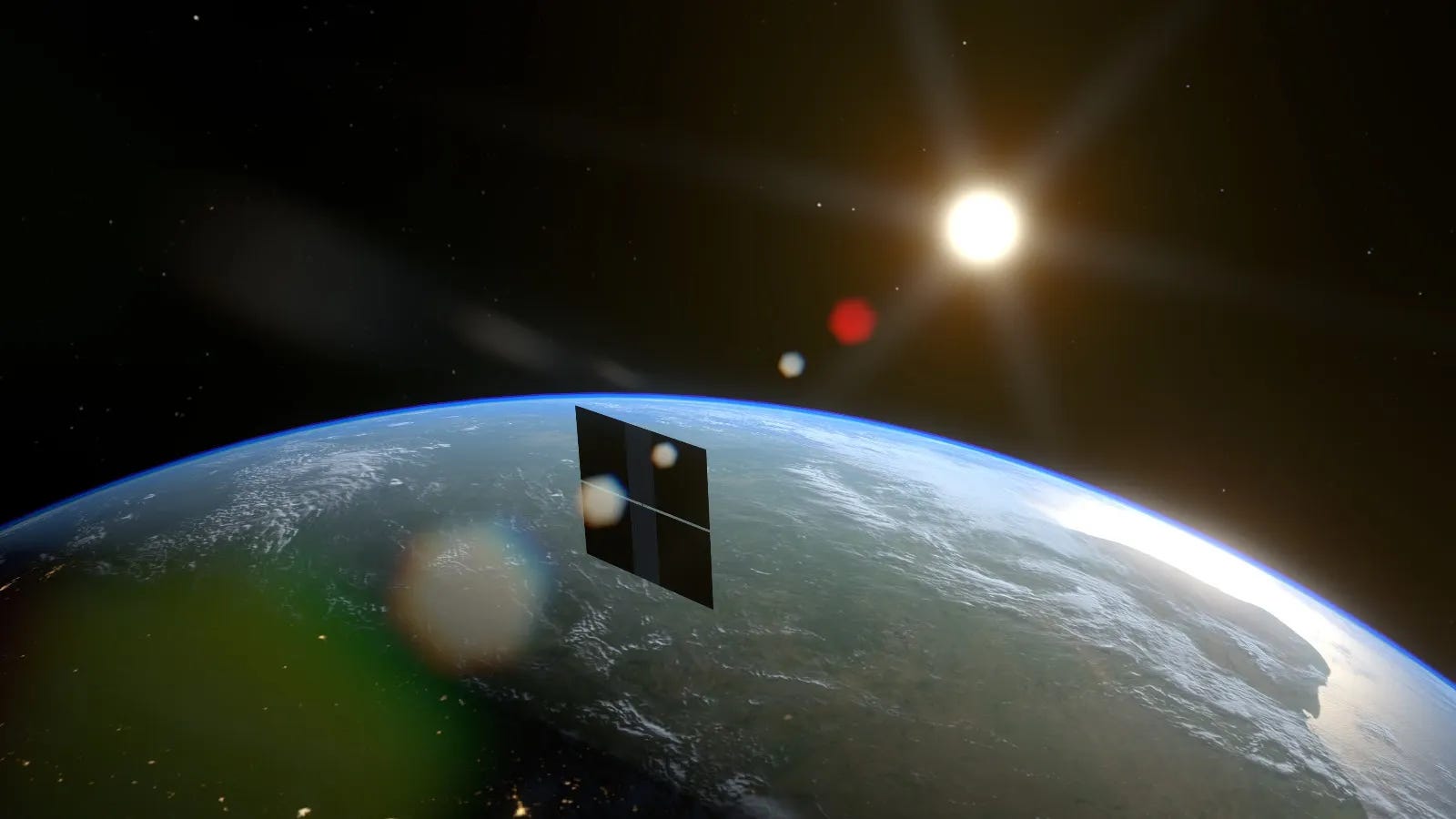
This month, Starcloud, a space startup from Redmond, Washington, took a giant leap by sending Nvidia H100 GPUs to space in a fridge-sized Starcloud-1 satellite.
On Sunday, the 132-pound Starcloud-1 was launched using SpaceX’s Falcon 9 rocket from Cape Canaveral Space Station in Florida.

The GPUs on the satellite are 100 times more powerful than any processor that has ever flown in space. They’re being used to process real-time data from other satellites. Instead of sending massive amounts of raw data to Earth for processing, which can cause delays, Starcloud-1 processes these high-resolution images directly in orbit.
The satellite is also testing Google’s Gemma AI, making it the first time a large AI model is operated in space.
If the mission succeeds, we could have a future where our AI chatbot conversations and meme posts on X will be processed in space rather than a building in West Virginia or Arizona.
One of the best-selling points for this initiative is that the data center will be using solar energy 24/7, and the vacuum of space for cooling, instead of water.
And that’s how these Starcloud projects can be operated 10 times more cheaply, and use zero water, compared to Earth-based data centers.
“In 10 years, nearly all new data centers will be being built in outer space,” Starcloud co-founder and CEO Philip Johnston predicts.
Too good to be true?
Let’s first talk power…
The phrase “terminator line” refers to an imaginary line that separates the daytime and the nighttime on Earth.
In low-Earth orbit, a satellite can access constant sunlight by following this terminator line. That’s how satellites get 24/7 heat access.
Starcloud-1, for instance, is equipped with deployable solar panels that provide up to 1 kilowatt of power without the need for batteries or backup systems.
Plus, these satellites won’t face issues that data centers on Earth face, like weather disruption and night-time downtime of solar power.
Next let’s talk water…
Data centers produce extraordinary amounts of heat from the data processing, so they need to be cooled down somehow.
On Earth, a data center could use millions of gallons of water daily. Cooling accounts for up to 40% of a data center’s energy use, often relying on evaporative systems that consume billions of gallons annually.
But in space, we can just release all that heat into the vacuum via radiative panels. Think of space as an “infinite heat sink” where there are no limits on how much heat we can emit from our space data centers.
Right now, the economics of space infrastructure are not good enough, but by 2030, Starcloud estimates all-in energy costs, including launch, at around 0.2 cents per kilowatt-hour, compared to about 5 cents per kilowatt-hour for new nuclear projects on Earth.
Over the lifetime of the data center, that would result in 10 times less CO2 emissions compared to Earth-based centers powered by fossil fuels.
A new space race?
We’ve come a long way from putting a man on the moon. We now have stadium-sized infrastructure in space.
This launch is not a one-off project, but a new booming economy and a new space race.
We have companies of all sizes, from startups like Starcloud and OrbitsEdge, to giants like Google, Blue Origins and Nvidia, all participating in making this reality happen.

Tech industry leaders like Jeff Bezos predict that gigawatt-scale data centers in space will exist within 10 to 20 years.
Eric Schmidt, ex-CEO of Google, acquired Relativity Space in March 2025 to pursue orbital data centers.
Schmidt has addressed the energy crisis in his congressional testimony where he noted that AI could demand 99% of all global electricity if nothing is done about this.
What about regulation?
Unlike on Earth, the regulatory landscape of space is a lot more open.
They face no local zoning battles, no community opposition over water usage, noise or pollution, no state-level environmental impact reviews, and no constraints from municipal power grid capacity.
All space activities are governed by the 1967 Outer Space Treaty, which establishes that countries are responsible for all national activities in outer space, regardless of whether they’re conducted by governmental or non-governmental entities.
And once a satellite is licensed and launched, it is now largely outside the scope of the terrestrial burdens, like zoning issues, advocacy group pushbacks, and permitting issues, that have delayed $64 billion worth of Earth-based data center projects since 2023.
While theoretically it sounds like the solution, space comes with its own set of challenges, such as massive emissions from rocket launches, extreme space conditions and the rising amount of space debris that could damage satellites.
As the volume of space compute stations rises, we should expect legislation to slowly catch up on topics like data sovereignty, liability for orbital collisions, space traffic management and long-term sustainability with orbital debris.
So, is all this the future of artificial intelligence or just another PR moonshot to increase company stock?
Either way, space-based data centers show how far we are willing to go to power the AI revolution.

Burry goes full sequel to The Big Short: The famed contrarian Michael Burry just disclosed a $1.1 billion bet against the AI trade, loading up on put options tied to Nvidia and Palantir and helping trigger a global tech sell-off as skittish markets suddenly imagine an AI bubble popping, instead of compounding forever, per Fortune.
Sky full of smart drones: In Liuyang, Hunan — China’s “Home of Fireworks” — a swarm of 16,000 AI-controlled drones just broke the world record for largest coordinated drone show, painting massive neon patterns in the sky and quietly previewing a future where fireworks, light shows, and maybe even battlefield formations are choreographed by algorithms instead of pyrotechnicians.

Brain-computer interface goes battlefield-ready: Israel’s Wearable Devices and X-trodes just delivered a touchless neural control system for advanced tactical ops, using SmartSkin EMG patches and AI algorithms so that soldiers can steer comms, navigation, and command systems with tiny neuromuscular signals — no hands, no screens, designed for extreme real-world environments.
Lab-grown antibodies go sci-fi: Nobel laureate David Baker’s team in Seattle just used a generative diffusion model to design antibodies from scratch with near-atomic accuracy, swapping years of animal testing and trial-and-error for weeks of compute — and signaling a drug discovery future where startups with the right AI stack can compete head-on with Big Pharma’s wet labs.